Description

Talent Hunters (Pvt.) Ltd. as a national HR consultancy firm of Pakistan, work with entrepreneurs to transform strategy into reality. We develop talent, help people be more effective, and motivate them to perform at their best. Our clients, we call them partners, come from the private, public, and not-for-profit sectors, across every industry. Their diverse business challenges mean we help them recognize and face their unique issues, as well as their unique challenges.

Tuesday, January 10, 2012

There isn't a big difference between CV and resume.


1: Different length.

Your resume should be shorter than your CV. Compare just your CV with your resume. Don't compare your documents with other people's documents. For example, your resume may be longer than somebody else's CV. If this is the case then it's not an issue.

As a general rule, a CV is expected to have a length of 2 or more pages. A resume should be less than 2 pages. A resume can be even shorter than 1 full page.


2: Similar sections.

Both a CV and a resume should include your full name, address, contact information, education work experience and skills. Don't add irrelevant sections to your resume and don't leave out essential sections from your CV.


3: Different sections.

In addition to a resume, a CV can and should include awards, teaching experience, hobbies, referees, grants and fellowships, diplomas, computer skills, work related skills, courses completed and any other relevant information.

For most positions, recruiters receive tens or even hundreds of applications. So, if you add lots of irrelevant information in a lengthy CV, your CV may be discarded. Along with the CV, you'll lose the chance of coming to an interview. To prevent this from ever happening, write a hassle free CV that's easy to understand. Use simple everyday English. Try to be clear rather than persuasive.


4: Underlining principles.

In both cases, make sure you write events in a chronological order. It's easier for people to understand events if they are a presented in a chronological order.

Your skills, experience and education are the most important aspects. Design your CV or resume around them.

While you write either a CV or a resume, pay particular attention to your writing. Writing concisely, clearly and simply shows that you think clearly and learn quickly. Writing, learning and thinking are all interrelated. Every word should mean something and it should add to the explanation. Write short phrases. Leave out any word which doesn't absolutely have to be part of the phrase.


5: Different rules in different countries.

In America, United States and Canada, use a resume as a general rule. In the rest of the world, a CV is expected and often demanded. However, most of the companies don't want lengthy CVs with irrelevant stuff in it. They do not care that much about your childhood or about what you did in your third grade. They want only the information that is relevant to the position you are applying for.

The perfect CV outside U.S. and Canada is less than 2 pages long and it has only the relevant information the employer needs. While a resume is about being brief, the perfect CV is about including only the relevant information. Keep in mind "brief vs relevant".


The above concepts and ideas represent the difference between CV and resume. Follow the above steps while you write your CV or resume. Don't ignore any of them.

Tuesday, December 27, 2011

What is Performance Management

Definition of Performance Management
The role of HR in the present scenario has undergone a sea change and its focus is on evolving such functional strategies which enable successful implementation of the major corporate strategies. In a way, HR and corporate strategies function in alignment. Today, HR works towards facilitating and improving the performance of the employees by building a conducive work environment and providing maximum opportunities to the employees for participating in organizational planning and decision making process. Today, all the major activities of HR are driven towards development of high performance leaders and fostering employee motivation. So, it can be interpreted that the role of HR has evolved from merely an appraiser to a facilitator and an enabler.
Performance management is the current buzzword and is the need in the current times of cut throat competition and the organizational battle for leadership. Performance management is a much broader and a complicated function of HR, as it encompasses activities such as joint goal setting, continuous progress
review and frequent communication, feedback and coaching for improved performance, implementation of employee development programmes and rewarding achievements. The process of performance management starts with the joining of a new incumbent in a system and ends when an employee quits the organization. Performance management can be regarded as a systematic process by which the overall performance of an organization can be improved by improving the performance of individuals within a team framework. It is a means for promoting superior performance by communicating expectations, defining roles within a required competence framework and establishing achievable benchmarks.
According to Armstrong and Baron (1998), Performance Management is both a strategic and an integrated approach to delivering successful results in organizations by improving the performance and developing the capabilities of teams and individuals. The term performance management gained its popularity in early 1980’s when total quality management programs received utmost importance for achievement of superior standards and quality performance. Tools such as job design, leadership development, training and reward system received an equal impetus along with the traditional performance appraisal process in the new comprehensive and a much wider framework. Performance management is an ongoing communication process which is carried between the supervisors and the employees through out the year. The process is very much cyclical and continuous in nature. A performance management system includes the following actions.
  • Developing clear job descriptions and employee performance plans which includes the key result areas (KRA') and performance indicators.
  • Selection of right set of people by implementing an appropriate selection process.
  • Negotiating requirements and performance standards for measuring the outcome and overall productivity against the predefined benchmarks.
  • Providing continuous coaching and feedback during the period of delivery of performance.
  • Identifying the training and development needs by measuring the outcomes achieved against the set standards and implementing effective development programs for improvement.
  • Holding quarterly performance development discussions and evaluating employee performance on the basis of performance plans.
  • Designing effective compensation and reward systems for recognizing those employees who excel in their jobs by achieving the set standards in accordance with the performance plans or rather exceed the performance benchmarks.
  • Providing promotional/career development support and guidance to the employees.
  • Performing exit interviews for understanding the cause of employee discontentment and thereafter exit from an organization.
performance management process sets the platform for rewarding excellence by aligning individual employee accomplishments with the organization’s mission and objectives and making the employee and the organization understand the importance of a specific job in realizing outcomes. By establishing clear performance expectations which includes results, actions and behaviors, it helps the employees in understanding what exactly is expected out of their jobs and setting of standards help in eliminating those jobs which are of no use any longer. Through regular feedback and coaching, it provides an advantage of diagnosing the problems at an early stage and taking corrective actions.
To conclude, performance management can be regarded as a proactive system of managing employee performance for driving the individuals and the organizations towards desired performance and results. It’s about striking a harmonious alignment between individual and organizational objectives for accomplishment of excellence in performance.

Human resource management system


Human Resource Management System (HRMS) or Human Resource Information System (HRIS), refers to the systems and processes at the intersection between human resource management (HRM) and information technology. It merges HRM as a discipline and in particular its basic HR activities and processes with the information technology field, whereas the programming of data processing systems evolved into standardized routines and packages of enterprise resource planning (ERP) software. On the whole, these ERP systems have their origin on software that integrates information from different applications into one universal database. The linkage of its financial and human resource modules through one database is the most important distinction to the individually and proprietary developed predecessors, which makes this software application both rigid and flexible.

[edit]Purpose

The function of Human Resources departments is generally administrative and common to all organizations. Organizations may have formalized selection, evaluation, and payroll processes. Efficient and effective management of "Human Capital" progressed to an increasingly imperative and complex process. The HR function consists of tracking existing employee data which traditionally includes personal histories, skills, capabilities, accomplishments and salary. To reduce the manual workload of these administrative activities, organizations began to electronically automate many of these processes by inroducing specialized Human Resource Management Systems. HR executives rely on internal or external IT professionals to develop and maintain an integrated HRMS. Before the client–server architecture evolved in the late 1980s, many HR automation processes were relegated to mainframe computers that could handle large amounts of data transactions. In consequence of the high capital investment necessary to buy or program proprietary software, these internally-developed HRMS were limited to organizations that possessed a large amount of capital. The advent of client–serverApplication Service Provider, and Software as a Service SaaS or Human Resource Management Systems enabled increasingly higher administrative control of such systems. Currently Human Resource Management Systems encompass:
  1. Payroll
  2. Work Time
  3. Appraisal performance
  4. Benefits Administration
  5. HR management Information system
  6. Recruiting/Learning Management # TrainingSystem
  7. Performance Record
  8. Employee Self-Service
The payroll module automates the pay process by gathering data on employee time and attendance, calculating various deductions and taxes, and generating periodic pay cheques and employee tax reports. Data is generally fed from the human resources and time keeping modules to calculate automatic deposit and manual cheque writing capabilities. This module can encompass all employee-related transactions as well as integrate with existing financial management systems.
The work time module gathers standardized time and work related efforts. The most advanced modules provide broad flexibility in data collection methods, labor distribution capabilities and data analysis features. Cost analysis and efficiency metrics are the primary functions.
The benefits administration module provides a system for organizations to administer and track employee participation in benefits programs. These typically encompass insurance, compensation, profit sharing and retirement.
The HR management module is a component covering many other HR aspects from application to retirement. The system records basic demographic and address data, selection, training and development, capabilities and skills management, compensation planning records and other related activities. Leading edge systems provide the ability to "read" applications and enter relevant data to applicable database fields, notify employers and provide position management and position control. Human resource management function involves the recruitment, placement, evaluation, compensation and development of the employees of an organization. Initially, businesses used computer based information systems to:
  • produce pay checks and payroll reports;
  • maintain personnel records;
  • pursue Talent Management.
Online recruiting has become one of the primary methods employed by HR departments to garner potential candidates for available positions within an organization. Talent Managementsystems typically encompass:
  • analyzing personnel usage within an organization;
  • identifying potential applicants;
  • recruiting through company-facing listings;
  • recruiting through online recruiting sites or publications that market to both recruiters and applicants.
The significant cost incurred in maintaining an organized recruitment effort, cross-posting within and across general or industry-specific job boards and maintaining a competitive exposure of availabilities has given rise to the development of a dedicated Applicant Tracking System, or 'ATS', module.
The training module provides a system for organizations to administer and track employee training and development efforts. The system, normally called a Learning Management System if a stand alone product, allows HR to track education, qualifications and skills of the employees, as well as outlining what training courses, books, CDs, web based learning or materials are available to develop which skills. Courses can then be offered in date specific sessions, with delegates and training resources being mapped and managed within the same system. Sophisticated LMS allow managers to approve training, budgets and calendars alongside performance management and appraisal metrics.
The Employee Self-Service module allows employees to query HR related data and perform some HR transactions over the system. Employees may query their attendance record from the system without asking the information from HR personnel. The module also lets supervisors approve O.T. requests from their subordinates through the system without overloading the task on HR department.
Many organizations have gone beyond the traditional functions and developed human resource management information systems, which support recruitment, selection, hiring, job placement, performance appraisals, employee benefit analysis, health, safety and security, while others integrate an outsourced Applicant Tracking System that encompasses a subset of the above.
Assigning Responsibilities Communication between the Employees.


Sunday, November 27, 2011

Roles and Functions of the HR Office in 21st Century.


Roles and Functions of the HR Office in 21st Century.
Long gone are the days when the HR function used to be handled by one person. The infamous “HR Lady” has now been replaced by a full pack of specialists in diverse HR functions. HR now seems to be the catch all when it comes to any facet of employee relations and company culture. Also, in the current employment environment, what constitutes Human Resources continues to evolve on a daily basis.
Lets take a look at the HR function in a typical large company. It may seem like the world’s most strenuous job sometimes, but there are definite benefits. Once we go through the list, you may realize that a job in HR may be the hotspot for career advancement and even provide semi-security from the unemployment surge.
HR Function and its roles and responsibilities
Ok. First up are those brave and valiant souls we call HR Generalists. The front line of an HR office, they deal most with the company’s employees and are responsible for many of the day to day operations. Their duties include:
- Explaining to a tenured employee why they have no more PTO (Paid time Off) time available.
- Researching and explaining the complex web of employee benefits.
- Assisting with interviews.
- Receiving and processing the fifty million possible types of employee forms.
- Payroll – Generating & Maintaining the effective, errorless payroll every single time.

A tenacious Recruiter is also critical to any HR department. Responsible for attracting and recruiting top talent, this person has their hands full. Also, guess who catches the heat if the employee from Hades makes their way through the screening process? Yep, you guessed right. This keeper of the gate is up to her elbows in:

* Sifting through a thousand and one resumes (some abysmal) and cover letters.
* Conducting phone screenings and scheduling interviews, in addition to listening to about a million voice messages.
* Walking raw recruits through computerized testing. Hey, didn’t her application say she was proficient in all Microsoft applications?
* Wading through qualifications, making offers, counter-offers, and pitching the company’s benefits.
* Maintaining a smile all day long at the local job fair. Someone buy that poor girl a Starbucks.

Trainers are also on the front line of shaping the organization. Critical to individuals at all levels of the organization, a successful training team is invaluable. They often have their finger on the pulse when it comes to the needs and complaints of the employees, and are invaluable in planning new initiatives. Perhaps one of the most undervalued positions, these folks:

* Conduct new-hire orientation and training. Someone has to get those raw recruits into shape.
* Support the functional departments with process training
* Shape the company culture through the use of soft skills and collaborative training modules.
* Provide an ear for frustrated employees.
* Perform the miracle of getting Susie in inventory control to become proficient in Microsoft Excel.
HR Managers are the glue that keeps it all together. Tasked with overseeing Generalists, Recruiters and Trainers, HR managers also have to ensure that the goals and objectives of Senior Leadership are being implemented across the organization. This can be a tightrope to walk, but the successful Manager knows how to maintain the delicate balance. Some critical responsibilities are:

* Ensuring the smooth running of the HR office.
* Gaining buy-in from the operations Managers and Supervisors for new policies.
* Conducting town hall meetings to disseminate new programs and guidelines to employees. Anyone hear crickets?
* Administering assimilation or team building exercises.
* Overseeing recruitment efforts.
* Developing incentive programs.
* Investigating claims of racism, sexism, and every other ism you can think of.
* Listening to the never ending list of employee issues and complaints.
* Everything else under the sun.
All jokes apart, HR is one of the most versatile and hardest working functions of any organization. They impact every aspect of the company and are stewards of its vision. HR engages in leadership and management development, employee counseling, community outreach, and a whole lot more.
By working in Human Resources, you gain a diverse skill set that can be transferred into so many other positions. A company simply could not function without your expertise and dedication. So the next time you feel down about your job, remember that HR runs the show.

Monday, November 21, 2011

List of Job Interview Questions


TOP 15 QUESTIONS FOR INTERVIEWING EMPLOYEES
■  At your last job, how did you fill downtime?
■  Tell me about your last performance review. What was mentioned about how you could improve? Any re-occurring themes?
■  Which situations kept you from coming to work on time at your last job? How often did that occur?
■  Describe a recent problem you had with one of your manager's decisions. Listen and then ask, how did you handle it?
■  What about your character makes you a good candidate for this job?
■  Priorities often change suddenly throughout the day. If you are asked to quickly do another task, how does that affect your mood? What if it's the third time before noon?
■  What do you feel is an acceptable amount of days to be absent in a calendar year?
■  How do you handle situations that could cause you to be tardy or absent?
■  How have you responded in the past when you found another employee was stealing?
■  24/7 operations are like relay races where you take the baton, run with it and then pass it on smoothly. How do you make seamless transitions on shift changes?
■  How have you responded in the past when your replacement calls in sick and a substitute will take over an hour to come in?
■  During the last year, when your replacement hasn’t shown up and your manager asked you to stay late, what percentage of the time have you stayed late?
■  Think about the last time your manager critiqued your work. How did you respond?
■  Give an example of when you did something without being asked. Can you give me another example?
■  Tell me about your most frustrating experience as a __________(job title)Listen and then ask, how did you handle it?

Tuesday, October 25, 2011

RECRUITMENT AND SELECTION IN PAKISTANI COMPANIES


INTRODUCTION TO TOPIC
(Recruitment and selection)
Human resource recruitment refers to any organizational activity that is designed to effect ,1)the number of people who apply for vacancies,2) the type of people who apply for them and/or, 3) the likelihood that those applying for vacancies will accept position if offered. The goal of any organization recruitment program is to ensure that the organization has a number of reasonably qualified applicants (who will find the job acceptable) to choose from when a vacancy occurs.
The goal of the recruiting is not simply to generate large number of applicants, if the process generates a sea of unqualified applicants, the organization will incur great expenses in personal selection, but few vacancies will actually be filled.
The goal of a personal recruitment is not to finely discriminate among reasonably qualified applicants either. Recruiting new personnel and selecting new personnel are both complex processes. Each task is hard enough to accomplish successfully .even when one is well focused. Organizations explicitly trying to do both at the same time will probably not to do either well.

DEFINITION OF RECRUITMENT.
Recruitment is the first part of the process of filling the vacancies; it includes the examination of the vacancies, the consideration of sources of suitable candidates, making contact with those candidates and attracting applications from them. (OR) All activities directed towards locating potential employees, (OR) the attraction of applications, form suitable applicants.
THE AIMS OF RECRUITMENT.
Organization does not operate in a vacuum and recruitment drives or one of the times when an organization has direct contact with the outside world. Other factors affecting recruitment or the framework impose by legislation, and the fact that no organization will want to spend money on unnecessary activities. In keeping with this and definition of recruitment given above the aims of recruitment are:
· To obtain pool of suitable candidates for vacant posts.
· To use and be seen to use a fair process
· To ensure that all recruitment activities contribute to company goals and a desirable company image
· To conduct recruitment activities in an efficient and cost effective manner
These statement intimate that a number of judgment to be made about how recruitment is carried out.
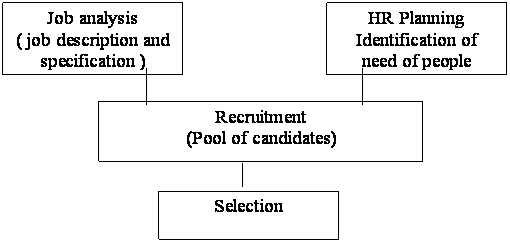
Figure illustrates the relationship among human resource planning, job analysis, recruitment, and the selection process.
clip_image001


RECRUITMENT SOURCES.
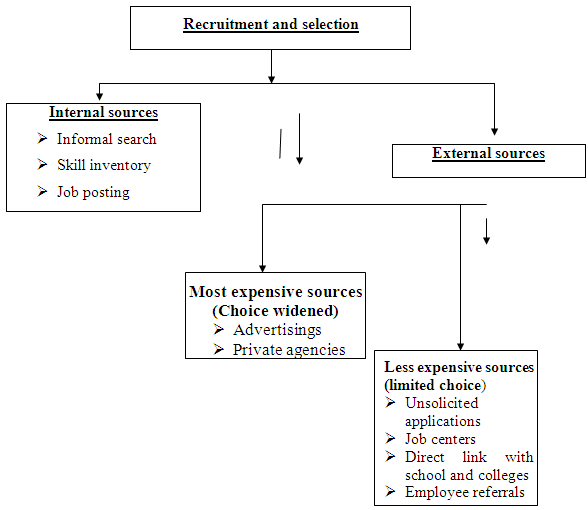
There are mainly two types of recruitment sources are used in the organization.
a) Internal sources
b) External sources
A diagram illustrates these
image

Monday, September 5, 2011

Issues in recruitment and selection


Issues in recruitment and selection

The tendency to employ people just like ourselves

Selection panels should not seek applicants who will 'fit in' because of characteristics irrelevant to the job. Research suggests that panel members subconsciously, or sometimes consciously, appoint people most like themselves. It is important to be aware of our own fears and prejudices which can arise from lack of experience with, say people from a different ethnic background. Openly discussing the criteria for the job and challenging discrimination in all steps of the process is essential in employing the best person for the job.

How people acquire and develop skills

Value should not be placed only on a traditional career path. Skills gained through unpaid volunteer work, participation in local or community organisations or managing a family can also be considered. Think broadly about how skills are developed and look for transferable skills.

Assumptions about the length of time an applicant may stay in the job

An applicant should not necessarily be disadvantaged by having gaps in their employment record, a history of part-time work, short term or volunteer work. Remember that childcare responsibilities still fall disproportionately on women and can be the cause of further discrimination in employment processes.

Place value on different types of work

Certain types of work should not necessarily be regarded as more valuable than others, for example childcare may, for certain positions, be as valuable an experience as paid work. Involvement in community organisations in a voluntary capacity builds many skills and competencies.

Who defines what is merit?

In the past, in a University context, merit has been defined by those people who had power. Their definition of merit rewarded unbroken service, overseas experience, a focus on research rather than teaching and it tended to benefit men over women. Perceptions, expectations, and requirements have changed, but all members of selection panels need to be vigilant to ensure that the University in practice achieves the merit based selection it requires.

Keeping up with current recruitment and selection practices

Members of selection panels, however experienced, must be in touch with new practices and procedures. Following policy and procedures is a great protection and assists in making good decisions based on merit. In addition the Equity and Diversity Awareness Program is open to all staff and can assist you in understanding your rights and obligations regarding discrimination.

Friday, August 5, 2011

Career path for young talents


Young talents should refrain from building a career in one particular sector. They should pursue a career based on understanding market trends, passion and development opportunities to be successful in their working life, say career experts.
“In our county, there is a strong tendency that a large group of graduates prefers a particular sector,” says M Zulfiquar Hussain, chief executive officer of Grow n Excel, a leading human resources and management consultation organisation in Bangladesh. “A few years back, many graduates opted for a career in telecoms and today, same thing is happening for the financial sector.”
A good graduate can build a career in any sector, given that he/she performs well and the organisation creates an enabling environment by nurturing, developing and retaining talent with appropriate people management practices, says Hussain.
Dr MA Mannan, professor of management studies at Dhaka University, says, “Many fresh graduates in our country make career decisions influenced by peer groups. But they should pursue a career by reviewing industry growth potential.”
So, the career experts ask young talents to make career decisions by understanding the trends, not following others blindly.
They say fresh graduates can explore opportunities in large local corporates in sectors like ready-made garments (RMG) and textile, information technology (IT), telecommunications, pharmaceuticals, hospitality and other service industries.
Today, local corporates have grown substantially and many organisations are going through transformations where growth perspective is enormous. In order to move forward, graduates in Bangladesh can contribute a lot more in these identified sectors, says Hussain.
Apart from the banking sector, there are many areas where they can explore their career. If one looks at economic indicators, the service sectors have done well in the recent past and trends are expected to be positive, he adds.
“The prospect of having a career in the RMG sector is also quite good as this industry is at a booming stage due to an increment in living costs in China,” says Saleh U Ahmed, head of HR, administration and compliance of IDS Group, a leading garments manufacturer and exporter in Bangladesh.
Global companies are looking for alternative destinations to source garments. Bangladesh will have preference because of cost competitiveness. Hence, the industry would require a lot of skilled human resources, says Ahmed.
Besides, a capable graduate can pursue a career in the RMG and textile industry because many leading group of companies have recently focused on developing their own talent pool by pursuing structured professional development programmes.
The IDS group provides both on-the-job and off-the-job training for its employees. “We have recently launched the management training programme to develop future leaders in this sector,” says Ahmed
He says they will recruit the next batch of management trainees this year. From now on, they plan to train them at Indian Institute of Management in Kolkata.
Aslam Baig, vice president for HRM and administration of Kohinoor Chemical Co (BD) Ltd, says the prospect of having a career in the fast moving consumer goods (FMCG) sector is good because it has steady growth over the last three decades. For example, Kohinoor, a leading local company in FMCG goods, has steady growth since in 1956, he claims.
The youth of today is smart enough regarding career choices. But they should consider job security, reasonable compensation, and a good working environment to choose a career, says Baig

Tuesday, June 21, 2011

WHATS NEW IN HUMAN RESOURCES ?


When browsing job listings, two of the first features that prospective talent looks for are the salary levels and the benefits packages. Hence the job of the best practices human resources firm is to make sure that these benefits and pay scales meet the company’s budget while remaining attractive and competitive enough to pull in the very best talent possible. Make sure that these figures put the company in a good light while also presenting themselves as engaging and competitive for your company’s recruitment efforts.

Another important aspect of best practices when it comes to providing optimal human resources services is the accurate and productive evaluation and enhancement of performance among the employee base. Indeed, performance management is one of the key functions of a human resources department, and should be approached with any one of a number of the proven techniques of metrics and evaluation that strives toward best practices in the realm of performance management.


Staying within the law is also another highly prominent aspect of human resources that comes into heavy play when discussing the best practices involved in keeping the workplace free of dangerous or contentious business practices. That’s why a good human resources department will thoroughly lawsuit-proof the workplace by making it compliant with the vast number of state and federal regulations in place for companies today.
A few of the more well-known issues include discrimination – which can take a wide variety of forms – as well as disability insurance, unemployment insurance, social security networks and a wide variety of other laws and rules that must be adhered to. Not only do these best legal practices help to promote a company that is free of regulatory complications, but it also helps to promote trust between the business leadership and the employee base.


As human resources is all about maintaining a positive and productive work environment, best practices helps to make sure that employees feel good about the company they work for.

Tuesday, May 24, 2011

Seven Steps To Increase Employee Retention


  1. Audits with behavioral assessments, cognitive reasoning assessments, job simulations, and hard skills assessments (e.g., computer skills, etc.) to objectively define the core competencies required for success in each role (competency modeling). This helps in providing a realistic job preview for candidates and managers. Oftentimes what managers think they need for a certain role is different from that they actually need.
  2. Implement a well-designed assessment and selection process. Include behavioral assessments and structured behavioral interviewing techniques to increase the likelihood of hiring people that can, and will, do the job at a high level in your environment and for your managers (job fit assessment).
  3. Provide good employee orientation. The people you hire today are potentially your greatest resource for corporate success in the years ahead. As a senior leader, your participation in new employee orientation sends a vital cultural and leadership message: "We’re all involved here in the drive toward what we want to be in the future." Everyone—even the newest employee—has value.
  4. Implement programs for employee training and development. Provide ongoing professional development to show your willingness as an organization to develop your greatest asset—your people.
  5. Improve manager and employee relationships. Concentrate on the people that stay with you to learn what makes them happy … then give them more of it! "People leave managers, not companies. If you have a turnover problem, look first at your managers.
  6. Provide an equitable or fair pay system. Be competitive!
  7. Encourage succession planning. Identify roles for which employees may be suited in the future and work with them on designing their succession plan within the organization. Invest in cross-training, job shadowing, coaching, mentoring, and cross-experience.
In summary, many organizations are already using several of the aforementioned steps, but may be lacking or deficient in the other steps. Each step is critical to the overall success of a comprehensive employee retention plan.