Description

Talent Hunters (Pvt.) Ltd. as a national HR consultancy firm of Pakistan, work with entrepreneurs to transform strategy into reality. We develop talent, help people be more effective, and motivate them to perform at their best. Our clients, we call them partners, come from the private, public, and not-for-profit sectors, across every industry. Their diverse business challenges mean we help them recognize and face their unique issues, as well as their unique challenges.

Tuesday, May 21, 2013

How to Improve Employee Retention: Attracting the Right Candidates

Over the years, Engage has implemented a number of policies that serve the dual purpose of attracting potential employees and keeping current ones passionate and committed. Here are a handful of examples:
  • Engage gives hiring priority to people who live near the office because they believe that long commutes are detrimental to work-life balance.
  • Instead of a traditional vacation policy, the company lets employees take time off from a leave bank, in which they can accumulate as many as 60 days off to use as they see fit. This policy has helped with employee retention, particularly by making it easier for female employees starting families to take time off and ultimately return to work.
  • During the hiring process, Engage administers the DISC Personality test, which charts the four characteristics, drive, influence, steadiness, and compliance, to build personality profiles for new hires. All employees' test results are public knowledge, which Hoffman feels helps people understand one another and get along.
  • By setting quarterly goals with rewards attached, such as iPods for the whole team or a trip to a nice restaurant, Engage can encourage employees beyond the competitive, and potentially divisive realm of salary bonuses. The group nature of these rewards is important, says Hoffman, because "somebody who is not motivated by getting an iPod knows that other people in his or her group are and doesn't want to let them down."
In addition to spurring employees to productivity, this team structure can make them happier in the workplace. Argote says, "there's evidence that being in cohesive work groups where members like each other reduces turnover."

Tuesday, April 9, 2013

The Role of Human Resource Management in Organizations


It's the people in an organization that carry out many important work activities. Managers and HR professionals have the important job of organizing people so that they can effectively perform these activities. This requires viewing people as human assets, not costs to the organization. Looking at people as assets is part of contemporary human resource management and human capital management.

Role of Human Resource Management

The human resources management team suggests to the management team how to strategically manage people as business resources. This includes managing recruiting and hiring employees, coordinating employee benefits and suggesting employee training and development strategies. In this way, HR professionals are consultants, not workers in an isolated business function; they advise managers on many issues related to employees and how they help the organization achieve its goals.

Collaboration

At all levels of the organization, managers and HR professionals work together to develop employees' skills. For example, HR professionals advise managers and supervisors how to assign employees to different roles in the organization, thereby helping the organization adapt successfully to its environment. In a flexible organization, employees are shifted around to different business functions based on business priorities and employee preferences.

Commitment Building

HR professionals also suggest strategies for increasing employee commitment to the organization. This begins with using the recruiting process or matching employees with the right positions according to their qualifications. Once hired, employees must be committed to their jobs and feel challenged throughout the year by their manager.

Building Capacity

An HRM team helps a business develop a competitive advantage, which involves building the capacity of the company so it can offer a unique set of goods or services to its customers. To build the an effective human resources, private companies compete with each other in a "war for talent." It's not just about hiring talent; this game is about keeping people and helping them grow and stay committed over the long term.

Tuesday, October 9, 2012

The Role of Management Accounting

What is the importance of accounting in building a successful home based business? There are three key aspects to managing small businesses:
  • marketing - spotting and filling a gap in the market
  • customer service - delivering on your marketing promises
  • money - achieving small business financial success
The importance of accounting is that it allows you to plan and track business performance. Are you making a profit? Are you collecting money from your customers quickly and efficiently? Can you pay your bills on time? Most importantly, is your cash flow improving or deteriorating?
When you drive a car, it's vital to look at the fuel gauge, and it's also important to pay attention to the speedometer and the temperature gauge. It's the same when you're driving a business forward - and you need to look at your 'accounting performance indicators' to see how your business is doing. True, you will already have a gut feel about it, but the figures give objective feedback.

TRACKING BUSINESS PERFORMANCE
Accounting is a method to record how your business is performing from a financial viewpoint. So, each real life activity of your small business gets 'accounted for'. Accounting is like a language that includes a mix of words and figures.
Rather than being translated from English to Spanish, accounting translates business activities into numbers that then get organized into particular reporting formats - such as small business financial statements.
The point about this is that you can tell a lot about a business by reading these financial statements - if you learn how to understand the language of accounts.

THE ROLE OF FINANCIAL ACCOUNTS
Financial accounts are the normal annual financial statements that every business has to produce. A standard set of small business financial statements includes two key documents:
  • a balance sheet, and
  • an income statement - also called a profit and loss account
However, these are not sufficient - and possibly not even the most important documents - for managing a small business. The tax authorities normally require a balance sheet and income statement, prepared according to standard accounting principles, so that they can charge you the right amount of tax.
In addition, your bank manager will want a copy of your annual financial accounts. However, they may also want to see more regular reports on the financial state of your business - and that's where management accounting comes in.

WHAT IS MANAGEMENT ACCOUNTING?
The role of management accounting is simply to provide you with important information on the performance of your business.
One of the key points about management accounts is that there are no strict rules. An owner of a small business prepares whatever figures they think might be useful, in whatever format they choose.
Typical management reports might include:
  • a monthly cash flow report
  • cash plans and income budgets
  • a list of customers who owe money, or suppliers you owe money
For any small business, a weekly or monthly cash flow report is critical. Many small businesses fail, and the reason they fail is because they run out of cash (cash meaning actual cash or money in the bank). It is quite possible to be showing a profit on your income statement but to run out of cash in the bank.
In summary, the importance of accounting is that it allows you to monitor the performance of your home based business while sitting at your desk. If you use accounting to record what happens, and turn those records into the right formats, you can get very useful information by learning how to read your financial and management accounts.

Thursday, July 26, 2012

Careers in sales and marketing; how much scope is there?


Sales and marketing

Sales and marketing are the business implementations which are vital for the constancy and progress of the any business and trade mechanism. Whether the business is small and have limited financial capabilities or it's a big budget business with powerful finical backup, only sales and marketing efficiency can help it to make an impact in the marketplace and earn suitable income. Sales and marketing are related to each other as the amount of marketing directly contributes to the sales and therefore marketing is essential for sales. Proper sales and marketing can boost the strength of the business where as poor sales and marketing can hinder the progress of the business and defame it in the public and corporate sector. There is a major scope for careers in sales and marketing as sales and marketing are the core aspect of any business and trade organizations.

Some of the career in sales and marketing includes:


Marketing and sales consultants

There is a lot of scope in marketing and sales consultant job. There are several businesses that seek expertise that can guide them to run a proper advertisement and promotional campaign and to boost sales using new and innovative marketing means. The marketing and sales consultants are required to answer the queries the business have. The marketing and sales consultant must have complete expertise in marketing mechanisms. There is much scope for this job and a person having proper marketing and sales consultancy skills can build a solid career in this field.


Sales and marketing management

This job is given much importance in the sales and marketing department. The scope of such job is vast as every organization seeks proper sales and marketing management. The manager is required to administer and monitor all the sales activities which are being carried out by the organization. The mechanism in which the sales and marketing strategy is built and carried out is also managed by the sales and marketing manager. The manager is given complete responsibility of devising management plans to entice sales and marketing.


Assistant Sales and Marketing Director

The assistance sales and marketing director is required to provide support to the sales and advertisement mechanism being implemented in the organization. The job description includes making survey, carrying new and innovative marketing trends and setting up new marketing mechanisms. The assistance sales and marketing director is also required to document the marketing and sales mechanism progress in the organization.


Internet Sales and Marketing Specialist

Career in sales and marketing on the internet is very vast. Every business require internet sales and marketing specialists to market the product on the internet which is a huge medium and is being visited by million of people every day. The business sector put special emphasis on internet sales and marketing as it's a powerful source of revenue generation and if the internet sales and marketing specialists devise new and innovative plans to boost internet sales then they are paid with suitable compensation and bonuses.


Thursday, June 14, 2012

Resource Management

In organizational studies, resource management is the efficient and effective deployment of an organization's resources when they are needed. Such resources may include financial resources, inventory, human skills, production resources, or information technology (IT).

In the realm of project management, processes, techniques and philosophies as to the best approach for allocating resources have been developed. These include discussions on functional vs. cross-functional resource allocation as well as processes espoused by organizations like the Project Management Institute (PMI) through their Project Management Body of Knowledge (PMBOK) methodology of project management. Resource management is a key element to activity resource estimating and project human resource management.

 Both are essential components of a comprehensive project management plan to execute and monitor a project successfully.[1][2] As is the case with the larger discipline of project management, there are resource management software tools available that automate and assist the process of resource allocation to projects and portfolio resource transparency including supply and demand of resources.

HR (Human Resource) Management
This is the science of allocating human resources among various projects or business units, maximizing the utilization of available personnel resources to achieve business goals; and performing the activities that are necessary in the maintenance of that workforce through identification of staffing requirements, planning and oversight of payroll and benefits, education and professional development, and administering their work-life needs. The efficient and effective deployment of an organization's personnel resources where and when they are needed, and in possession of the tools, training and skills required by the work.

Friday, May 18, 2012

Salary negotiation is a skill that once learned can take your earning power to new levels.
Stepping into a situation of discussing salary requirements is never easy. You really want the job, but you want to be paid well also. You deserve to be paid well after all. How do you convey this to your potential employer?

It can be very intimidating and difficult to discuss this issue in a productive manner. The company knows what its limits are. They also recognize that you require a certain amount to satisfy your ability and qualifications. Listed below are 7 steps to help you get into the right frame of mind- your salary negotiation mode.

Salary Negotiation Tips

  1. Look the part. If you want to make a million bucks, you need to look like a million bucks. In preparation for all of your interviews and meetings, be well dressed. Invest in a manicure, and buy a new suit or other appropriate outfit. If your hair is colored or highlighted, make sure that there are no roots showing. Not only will these investments make you more appealing to an employer, they will make you feel better about yourself. When going into salary negotiations, you need all the confidence that you can get. Looking at yourself dressed up and ready to take on the world, you will feel better about yourself. You need to be pumped up and expect to achieve the salary that you deserve.
  2. Patience is key. Don’t rush into salary negotiations. Be patient and hold out on discussions until after the job has been securely offered to you. If you are required to provide an expected salary, be vague and offer a range or state that the amount is conditional upon the job specifics. Whatever you do, don’t pinpoint your salary goal while others are still in the candidate pool. Wait for the employer to give you a starting number to begin negotiations. Generally the person hiring will leave room for a 10%-20% increase from the starting point depending upon the candidates specific qualifications. So wait for the employers number, then go from there.
  3. Be well informed. Don’t go into negotiations without being educated upon the fair market value of your position. Find out what other companies are paying for this job. Although you can’t fling this in your employer ‘s face, it can help you to determine appropriate negotiating steps to take.
  4. Know what you’ve got. Try to determine how your education and experience level stacks up against others in your position at other companies, as well as within the company you are dealing with. Figure out which of your features you should highlight. Would you be the only one in your department with a masters degree? Do you have more years of experience than others? Find your selling point and use it. Perhaps it is simply your positive attitude and self-motivated work ethic. Set yourself apart, and make the employer want to pay you top dollar.
  5. Stay focused. When dealing with the company, pay attention to clues which may reveal values and qualities which they particularly seek in an employee. This can help you to determine which of your own qualities to highlight during negotiations.
  6. You are desirable. Sell yourself. The company obviously wants you or they would not be offering the job to you. Adopt the right attitude. You don’t want to appear arrogant, but there is no harm in letting your employer know that you are worth paying extra for.
  7. Perhaps the most basic but also important step to achieving the correct salary negotiation mode is to maintain a positive attitude. Go into negotiations believing that you are worth the salary that you want. Make them buy you for a reasonable market value, but one that is fair and takes into account your additional qualities.

Monday, April 9, 2012

What to Know Before you Work in Dubai


To work in Dubai, there are lots of things that you should first know about. You have to be prepared in order to work in Dubai and a good starting point as a tip could be to look for a list of sources for all the best possible available jobs in Dubai. Another important factor when you want to work in Dubai is to see a list of all the Recruitment agencies that you can find and have it reserved in your table based in distance because people who want to work in Dubai like you usually do not have any clue. You can visit recognized agencies that offer work in Dubai  while you can go direct where there are also a lot of Agencies with corresponding job offers for Dubai in the U.A.E. Don’t forget about the compensation because it is the main purpose of getting a work in Dubai.

Dubai Recruitment Agency Reputation
After you already have the list of the recruitment agencies in Dubai, compensation that you will get in Dubai and jobs offered in Dubai, you can try and see who has the best reputation by trying to call them or via an e-mail and seek for details in the internet to see who’s who in the industry of work in Dubai and agencies that has served people for so many years. The years of service is one of the most important thing to know in this business because agencies cannot be there and serve people best, any work in Dubai if they are new to the business. Usually, reputation may be best measured by the length or year of service. Then, try to seek and if possible, talk to anyone who has been employed by the agency that you chose fit to serve you. From there, you can personally ask details and whereabouts of the said company.
 
Find Job
Recruitment agencies can be the best source for the best jobs in Dubai. The Dubai jobs market can be quite competitive and many important positions can only be found by going through recruitment agencies. If you are serious about finding a job in Dubai, make sure you register with all the recruitment agencies and keep checking their job openings on their web site. Once you find a job opportunity that matches your skills and interests, you can contact the recruitment agency and provide them with only your registration number. You will find listings of jobs in the below list of local papers, but most of them are advertised by the recruitment agencies in the UAE and Middle East region. You will also find more Dubai jobs listed in the recruitment agency website where you can apply directly online.
Many companies outside the UAE hire recruitment agencies in Dubai to do the hiring for them because of the vast numbers and quality of professionals in Dubai
After choosing which work you qualify for, you can go to the next step which is to seek for the highest possible compensation that you can get if you are to work in Dubai.
 
Work Contract in Dubai
The work contract is also a very important factor for most people who want to work in Dubai because it is also a major consideration in terms of financial computation. This is in knowing if you can gain financial stability within the contract of employment itself. Usually, longer contracts work best like 1 year or 2 years to avoid home sickness and to take a little vacation every after a 6-month duration or a 1-year stay. Bear in mind that knowing the contract is the number one purpose for people who want to work in other places like Dubai and any other country as well. This is also where you will estimate your capabilities with respect to working conditions and specific job description.
 
Work Accommodation Package
Working abroad, like in Dubai is something that will take you at least a 6-month stay in the country and it is of utmost concern to know whether you can avail of accommodation amenities or if the work goes with a package accommodation like free food and lodging. It is something very important as part of working abroad because this is where you will get extra income from especially if you do not need to worry about food and a decent place to stay.

Saturday, February 18, 2012

Frequently Asked Interview Questions


Kelly wants to help you successfully advance your career objectives. We've spent more than 60 years interviewing and being interviewed and have compiled a list of some of the most common interview questions and effective, appropriate responses. Be prepared, be yourself and make sure you're ready to answer some tough questions.

"Tell me about yourself..."
Be prepared to talk for two minutes about yourself. Be logical. Start anywhere, such as high school, college or your first professional position. The interviewer is trying to evaluate your communication skills and linear thinking. You may try to score a point or two by describing a major personal attribute.

"Why are you leaving your current position?"
This is a very critical question. Don't bad mouth your previous employer or co-workers or sound too opportunistic. It's fine to mention major problems, a buy-out or a shutdown. You may want to state that after long personal consideration, your chance to make a contribution is very low due to extensive company-wide changes.

"What do you consider your most significant accomplishment?"
A good answer to this question can get you the job. Prepare extensively—discuss hard work, long hours, pressure and important company issues at stake. You may want to tell a two minute detailed story, discussing personal involvement.

"Why do you believe you are qualified for this position?"
Pick two or three main factors about the job and about yourself that are most relevant. Discuss for two minutes, including specific details. You may mention a technical skill, a management skill and/or a personal success story.

"Have you ever accomplished something you didn't think you could?"
The interviewer is trying to determine your goal orientation, work ethic, personal commitment and integrity. Prepare a good example where you overcame difficulties and succeeded. Prove that you're not a quitter.

"What do you like/dislike most about your current or last position?"
The interviewer is trying to determine compatibility with the open position. Be careful; don't say you dislike overtime, management, or get too detailed. It's safe to say that you like challenges, pressure situations, opportunities to grow, or that you dislike bureaucracy and frustrating situations.

"How do you handle pressure? Do you like or dislike these situations?"
High achievers tend to perform well in high-pressure situations. Conversely, these questions could imply that the open position is pressure-packed and out of control. Know what you're getting into. If you do perform well under stress, provide a good, detailed example. Be descriptive.

"The sign of a good employee is the ability to take initiative. Can you describe a situation where you did this?"
The proactive, results-oriented person doesn't have to be told what to do. To convince the interviewer you possess this trait, give a series of short examples describing your self-motivation. Discuss one example in-depth, describing the extra effort, your strong work ethic and your creative, resourceful side.

"What was the worst/most embarrassing situation of your career? How would you have done things differently with 20/20 hindsight?"
Your interviewer wants to know how introspective you are, and to see if you can learn from your mistakes. Don't be afraid to talk candidly about your failures, especially if you learned something significant from them.

"How have you grown or changed over the past few years?"
Maturation, increased technical skills and increased self-confidence are important developmental aspects. To discuss these effectively is indicative of a well-balanced, intelligent individual. Overcoming personal obstacles or recognizing manageable weaknesses can help identify you as an approachable and desirable employee.

"What do you consider your most significant strength?"
Know your key five or six strengths—the ones most compatible with the job opening. Discuss each with specific examples. Don't include your management or interpersonal skills unless you can describe specific examples of good management, or how your relationship skills have been critical to your success.

"Deadlines, frustrations, difficult people and silly rules can make a job difficult. How do you handle these types of situations?"
Most companies, unfortunately, face these problems daily. If you can't deal with petty problems, you'll be seen as uncooperative. How you overcome these are important. Diplomacy, perseverance and common sense will prevail in difficult circumstances.

"One of our biggest problems is… What has been your experience with this? How would you deal with it?"
Think on your feet. Ask questions to get more details and break the problem into subsections. It is highly likely that you will have had some experience dealing with the subsections. Answer these and summarize the total. If you can't answer directly, state how you would go about solving the problem. Be specific and show your organizational and analytical skills.

"How has your technical ability been important in accomplishing results?"
A potential employee needs a strong level of technical competence. Most strong managers have good technical backgrounds. Describe specific examples of your technical abilities, and how you resolved a technical issue.

"How would you handle a situation with tight deadlines, low employee morale and inadequate resources?"
Your interviewer is looking for strong management skills. You need to be creative and describe your toughest management task, even if it doesn't meet all the criteria. Most situations don't. Organizational and interpersonal skills, handling pressure and good handling of this question are indicative of effective management skills.

"Are you satisfied with your career to date? What would you change if you could?"
Be honest. The interviewer wants to know if you'll be happy. Are you willing to make some sacrifices to get your career on the right track? Your degree of motivation is an important selection factor.

"What are your career goals? Where do you see yourself five or ten years from now?"
Be realistic! Pie-in-the-sky goals label you as immature. One or two management jumps in 3-5 years is a reasonable goal. If your track record indicates you're in line for senior management in 10 years, then mention it. If you've had a rocky road, be introspective.

"Why should we hire you for this position? What kinds of contributions would you make?"
This is a good chance to summarize. By now, you should know the key problems. Restate and show how you would address them. Don't be arrogant—instead demonstrate a thoughtful, organized and strong attitude

Tuesday, January 31, 2012

Definition of 'Intangible Asset'


Definition of 'Intangible Asset'

An asset that is not physical in nature. Corporate intellectual property (items such as patents, trademarks, copyrights, business methodologies), goodwill and brand recognition are all common intangible assets in today's marketplace. An intangible asset can be classified as either indefinite or definite depending on the specifics of that asset. A company brand name is considered to be an indefinite asset, as it stays with the company as long as the company continues operations. However, if a company enters a legal agreement to operate under another company's patent, with no plans of extending the agreement, it would have a limited life and would be classified as a definite asset.

Investopedia explains 'Intangible Asset'

While intangible assets don't have the obvious physical value of a factory or equipment, they can prove very valuable for a firm and can be critical to its long-term success or failure. For example, a company such as Coca-Cola wouldn't be nearly as successful were it not for the high value obtained through its brand-name recognition. Although brand recognition is not a physical asset you can see or touch, its positive effects on bottom-line profits can prove extremely valuable to firms such as Coca-Cola, whose brand strength drives global sales year after year.

Friday, January 27, 2012

What is Human resource management (HRM, or simply HR)

Human resource management (HRM, or simply HR) is the management of an organization's human resources. It is responsible for the attraction, selection, training, assessment, and rewarding of employees, while also overseeing organizational leadership and culture, and ensuring compliance with employment and labor laws. In circumstances where employees desire and are legally authorized to hold a collective bargaining agreement, HR will typically also serve as the company's primary liaison with the employees' representatives (usually a labor union).
HR is a product of the human relations movement of the early 20th century, when researchers began documenting ways of creating business value through the strategic management of the workforce. The function was initially dominated by transactional work such as payroll and benefits administration, but due to globalization, company consolidation, technological advancement, and further research, HR now focuses on strategic initiatives like mergers and acquisitions, talent management, succession planning, industrial and labor relations, and diversity and inclusion.
Whereas in startup companies HR's duties may be performed by a handful of trained professionals or even by non-HR personnel, larger companies typically house an entire functional group dedicated to the discipline, with staff specializing in various HR tasks and functional leadership engaging in strategic decision making across the business. To train practitioners for the profession, institutions of higher education, professional associations, and companies themselves have created programs of study dedicated explicitly to the duties of the function. Academic and practitioner organizations likewise seek to engage and further the field of HR, as evidenced by several field-specific publications.

Tuesday, January 10, 2012

There isn't a big difference between CV and resume.


1: Different length.

Your resume should be shorter than your CV. Compare just your CV with your resume. Don't compare your documents with other people's documents. For example, your resume may be longer than somebody else's CV. If this is the case then it's not an issue.

As a general rule, a CV is expected to have a length of 2 or more pages. A resume should be less than 2 pages. A resume can be even shorter than 1 full page.


2: Similar sections.

Both a CV and a resume should include your full name, address, contact information, education work experience and skills. Don't add irrelevant sections to your resume and don't leave out essential sections from your CV.


3: Different sections.

In addition to a resume, a CV can and should include awards, teaching experience, hobbies, referees, grants and fellowships, diplomas, computer skills, work related skills, courses completed and any other relevant information.

For most positions, recruiters receive tens or even hundreds of applications. So, if you add lots of irrelevant information in a lengthy CV, your CV may be discarded. Along with the CV, you'll lose the chance of coming to an interview. To prevent this from ever happening, write a hassle free CV that's easy to understand. Use simple everyday English. Try to be clear rather than persuasive.


4: Underlining principles.

In both cases, make sure you write events in a chronological order. It's easier for people to understand events if they are a presented in a chronological order.

Your skills, experience and education are the most important aspects. Design your CV or resume around them.

While you write either a CV or a resume, pay particular attention to your writing. Writing concisely, clearly and simply shows that you think clearly and learn quickly. Writing, learning and thinking are all interrelated. Every word should mean something and it should add to the explanation. Write short phrases. Leave out any word which doesn't absolutely have to be part of the phrase.


5: Different rules in different countries.

In America, United States and Canada, use a resume as a general rule. In the rest of the world, a CV is expected and often demanded. However, most of the companies don't want lengthy CVs with irrelevant stuff in it. They do not care that much about your childhood or about what you did in your third grade. They want only the information that is relevant to the position you are applying for.

The perfect CV outside U.S. and Canada is less than 2 pages long and it has only the relevant information the employer needs. While a resume is about being brief, the perfect CV is about including only the relevant information. Keep in mind "brief vs relevant".


The above concepts and ideas represent the difference between CV and resume. Follow the above steps while you write your CV or resume. Don't ignore any of them.

Tuesday, December 27, 2011

What is Performance Management

Definition of Performance Management
The role of HR in the present scenario has undergone a sea change and its focus is on evolving such functional strategies which enable successful implementation of the major corporate strategies. In a way, HR and corporate strategies function in alignment. Today, HR works towards facilitating and improving the performance of the employees by building a conducive work environment and providing maximum opportunities to the employees for participating in organizational planning and decision making process. Today, all the major activities of HR are driven towards development of high performance leaders and fostering employee motivation. So, it can be interpreted that the role of HR has evolved from merely an appraiser to a facilitator and an enabler.
Performance management is the current buzzword and is the need in the current times of cut throat competition and the organizational battle for leadership. Performance management is a much broader and a complicated function of HR, as it encompasses activities such as joint goal setting, continuous progress
review and frequent communication, feedback and coaching for improved performance, implementation of employee development programmes and rewarding achievements. The process of performance management starts with the joining of a new incumbent in a system and ends when an employee quits the organization. Performance management can be regarded as a systematic process by which the overall performance of an organization can be improved by improving the performance of individuals within a team framework. It is a means for promoting superior performance by communicating expectations, defining roles within a required competence framework and establishing achievable benchmarks.
According to Armstrong and Baron (1998), Performance Management is both a strategic and an integrated approach to delivering successful results in organizations by improving the performance and developing the capabilities of teams and individuals. The term performance management gained its popularity in early 1980’s when total quality management programs received utmost importance for achievement of superior standards and quality performance. Tools such as job design, leadership development, training and reward system received an equal impetus along with the traditional performance appraisal process in the new comprehensive and a much wider framework. Performance management is an ongoing communication process which is carried between the supervisors and the employees through out the year. The process is very much cyclical and continuous in nature. A performance management system includes the following actions.
  • Developing clear job descriptions and employee performance plans which includes the key result areas (KRA') and performance indicators.
  • Selection of right set of people by implementing an appropriate selection process.
  • Negotiating requirements and performance standards for measuring the outcome and overall productivity against the predefined benchmarks.
  • Providing continuous coaching and feedback during the period of delivery of performance.
  • Identifying the training and development needs by measuring the outcomes achieved against the set standards and implementing effective development programs for improvement.
  • Holding quarterly performance development discussions and evaluating employee performance on the basis of performance plans.
  • Designing effective compensation and reward systems for recognizing those employees who excel in their jobs by achieving the set standards in accordance with the performance plans or rather exceed the performance benchmarks.
  • Providing promotional/career development support and guidance to the employees.
  • Performing exit interviews for understanding the cause of employee discontentment and thereafter exit from an organization.
A performance management process sets the platform for rewarding excellence by aligning individual employee accomplishments with the organization’s mission and objectives and making the employee and the organization understand the importance of a specific job in realizing outcomes. By establishing clear performance expectations which includes results, actions and behaviors, it helps the employees in understanding what exactly is expected out of their jobs and setting of standards help in eliminating those jobs which are of no use any longer. Through regular feedback and coaching, it provides an advantage of diagnosing the problems at an early stage and taking corrective actions.
To conclude, performance management can be regarded as a proactive system of managing employee performance for driving the individuals and the organizations towards desired performance and results. It’s about striking a harmonious alignment between individual and organizational objectives for accomplishment of excellence in performance.

Human resource management system


A Human Resource Management System (HRMS) or Human Resource Information System (HRIS), refers to the systems and processes at the intersection between human resource management (HRM) and information technology. It merges HRM as a discipline and in particular its basic HR activities and processes with the information technology field, whereas the programming of data processing systems evolved into standardized routines and packages of enterprise resource planning (ERP) software. On the whole, these ERP systems have their origin on software that integrates information from different applications into one universal database. The linkage of its financial and human resource modules through one database is the most important distinction to the individually and proprietary developed predecessors, which makes this software application both rigid and flexible.

[edit]Purpose

The function of Human Resources departments is generally administrative and common to all organizations. Organizations may have formalized selection, evaluation, and payroll processes. Efficient and effective management of "Human Capital" progressed to an increasingly imperative and complex process. The HR function consists of tracking existing employee data which traditionally includes personal histories, skills, capabilities, accomplishments and salary. To reduce the manual workload of these administrative activities, organizations began to electronically automate many of these processes by inroducing specialized Human Resource Management Systems. HR executives rely on internal or external IT professionals to develop and maintain an integrated HRMS. Before the client–server architecture evolved in the late 1980s, many HR automation processes were relegated to mainframe computers that could handle large amounts of data transactions. In consequence of the high capital investment necessary to buy or program proprietary software, these internally-developed HRMS were limited to organizations that possessed a large amount of capital. The advent of client–server, Application Service Provider, and Software as a Service SaaS or Human Resource Management Systems enabled increasingly higher administrative control of such systems. Currently Human Resource Management Systems encompass:
  1. Payroll
  2. Work Time
  3. Appraisal performance
  4. Benefits Administration
  5. HR management Information system
  6. Recruiting/Learning Management # TrainingSystem
  7. Performance Record
  8. Employee Self-Service
The payroll module automates the pay process by gathering data on employee time and attendance, calculating various deductions and taxes, and generating periodic pay cheques and employee tax reports. Data is generally fed from the human resources and time keeping modules to calculate automatic deposit and manual cheque writing capabilities. This module can encompass all employee-related transactions as well as integrate with existing financial management systems.
The work time module gathers standardized time and work related efforts. The most advanced modules provide broad flexibility in data collection methods, labor distribution capabilities and data analysis features. Cost analysis and efficiency metrics are the primary functions.
The benefits administration module provides a system for organizations to administer and track employee participation in benefits programs. These typically encompass insurance, compensation, profit sharing and retirement.
The HR management module is a component covering many other HR aspects from application to retirement. The system records basic demographic and address data, selection, training and development, capabilities and skills management, compensation planning records and other related activities. Leading edge systems provide the ability to "read" applications and enter relevant data to applicable database fields, notify employers and provide position management and position control. Human resource management function involves the recruitment, placement, evaluation, compensation and development of the employees of an organization. Initially, businesses used computer based information systems to:
  • produce pay checks and payroll reports;
  • maintain personnel records;
  • pursue Talent Management.
Online recruiting has become one of the primary methods employed by HR departments to garner potential candidates for available positions within an organization. Talent Managementsystems typically encompass:
  • analyzing personnel usage within an organization;
  • identifying potential applicants;
  • recruiting through company-facing listings;
  • recruiting through online recruiting sites or publications that market to both recruiters and applicants.
The significant cost incurred in maintaining an organized recruitment effort, cross-posting within and across general or industry-specific job boards and maintaining a competitive exposure of availabilities has given rise to the development of a dedicated Applicant Tracking System, or 'ATS', module.
The training module provides a system for organizations to administer and track employee training and development efforts. The system, normally called a Learning Management System if a stand alone product, allows HR to track education, qualifications and skills of the employees, as well as outlining what training courses, books, CDs, web based learning or materials are available to develop which skills. Courses can then be offered in date specific sessions, with delegates and training resources being mapped and managed within the same system. Sophisticated LMS allow managers to approve training, budgets and calendars alongside performance management and appraisal metrics.
The Employee Self-Service module allows employees to query HR related data and perform some HR transactions over the system. Employees may query their attendance record from the system without asking the information from HR personnel. The module also lets supervisors approve O.T. requests from their subordinates through the system without overloading the task on HR department.
Many organizations have gone beyond the traditional functions and developed human resource management information systems, which support recruitment, selection, hiring, job placement, performance appraisals, employee benefit analysis, health, safety and security, while others integrate an outsourced Applicant Tracking System that encompasses a subset of the above.
Assigning Responsibilities Communication between the Employees.


Sunday, November 27, 2011

Roles and Functions of the HR Office in 21st Century.


Roles and Functions of the HR Office in 21st Century.
Long gone are the days when the HR function used to be handled by one person. The infamous “HR Lady” has now been replaced by a full pack of specialists in diverse HR functions. HR now seems to be the catch all when it comes to any facet of employee relations and company culture. Also, in the current employment environment, what constitutes Human Resources continues to evolve on a daily basis.
Lets take a look at the HR function in a typical large company. It may seem like the world’s most strenuous job sometimes, but there are definite benefits. Once we go through the list, you may realize that a job in HR may be the hotspot for career advancement and even provide semi-security from the unemployment surge.
HR Function and its roles and responsibilities
Ok. First up are those brave and valiant souls we call HR Generalists. The front line of an HR office, they deal most with the company’s employees and are responsible for many of the day to day operations. Their duties include:
- Explaining to a tenured employee why they have no more PTO (Paid time Off) time available.
- Researching and explaining the complex web of employee benefits.
- Assisting with interviews.
- Receiving and processing the fifty million possible types of employee forms.
- Payroll – Generating & Maintaining the effective, errorless payroll every single time.

A tenacious Recruiter is also critical to any HR department. Responsible for attracting and recruiting top talent, this person has their hands full. Also, guess who catches the heat if the employee from Hades makes their way through the screening process? Yep, you guessed right. This keeper of the gate is up to her elbows in:

* Sifting through a thousand and one resumes (some abysmal) and cover letters.
* Conducting phone screenings and scheduling interviews, in addition to listening to about a million voice messages.
* Walking raw recruits through computerized testing. Hey, didn’t her application say she was proficient in all Microsoft applications?
* Wading through qualifications, making offers, counter-offers, and pitching the company’s benefits.
* Maintaining a smile all day long at the local job fair. Someone buy that poor girl a Starbucks.

Trainers are also on the front line of shaping the organization. Critical to individuals at all levels of the organization, a successful training team is invaluable. They often have their finger on the pulse when it comes to the needs and complaints of the employees, and are invaluable in planning new initiatives. Perhaps one of the most undervalued positions, these folks:

* Conduct new-hire orientation and training. Someone has to get those raw recruits into shape.
* Support the functional departments with process training
* Shape the company culture through the use of soft skills and collaborative training modules.
* Provide an ear for frustrated employees.
* Perform the miracle of getting Susie in inventory control to become proficient in Microsoft Excel.
HR Managers are the glue that keeps it all together. Tasked with overseeing Generalists, Recruiters and Trainers, HR managers also have to ensure that the goals and objectives of Senior Leadership are being implemented across the organization. This can be a tightrope to walk, but the successful Manager knows how to maintain the delicate balance. Some critical responsibilities are:

* Ensuring the smooth running of the HR office.
* Gaining buy-in from the operations Managers and Supervisors for new policies.
* Conducting town hall meetings to disseminate new programs and guidelines to employees. Anyone hear crickets?
* Administering assimilation or team building exercises.
* Overseeing recruitment efforts.
* Developing incentive programs.
* Investigating claims of racism, sexism, and every other ism you can think of.
* Listening to the never ending list of employee issues and complaints.
* Everything else under the sun.
All jokes apart, HR is one of the most versatile and hardest working functions of any organization. They impact every aspect of the company and are stewards of its vision. HR engages in leadership and management development, employee counseling, community outreach, and a whole lot more.
By working in Human Resources, you gain a diverse skill set that can be transferred into so many other positions. A company simply could not function without your expertise and dedication. So the next time you feel down about your job, remember that HR runs the show.

Monday, November 21, 2011

List of Job Interview Questions


TOP 15 QUESTIONS FOR INTERVIEWING EMPLOYEES
■  At your last job, how did you fill downtime?
■  Tell me about your last performance review. What was mentioned about how you could improve? Any re-occurring themes?
■  Which situations kept you from coming to work on time at your last job? How often did that occur?
■  Describe a recent problem you had with one of your manager's decisions. Listen and then ask, how did you handle it?
■  What about your character makes you a good candidate for this job?
■  Priorities often change suddenly throughout the day. If you are asked to quickly do another task, how does that affect your mood? What if it's the third time before noon?
■  What do you feel is an acceptable amount of days to be absent in a calendar year?
■  How do you handle situations that could cause you to be tardy or absent?
■  How have you responded in the past when you found another employee was stealing?
■  24/7 operations are like relay races where you take the baton, run with it and then pass it on smoothly. How do you make seamless transitions on shift changes?
■  How have you responded in the past when your replacement calls in sick and a substitute will take over an hour to come in?
■  During the last year, when your replacement hasn’t shown up and your manager asked you to stay late, what percentage of the time have you stayed late?
■  Think about the last time your manager critiqued your work. How did you respond?
■  Give an example of when you did something without being asked. Can you give me another example?
■  Tell me about your most frustrating experience as a __________(job title). Listen and then ask, how did you handle it?

Tuesday, October 25, 2011

RECRUITMENT AND SELECTION IN PAKISTANI COMPANIES


INTRODUCTION TO TOPIC
(Recruitment and selection)
Human resource recruitment refers to any organizational activity that is designed to effect ,1)the number of people who apply for vacancies,2) the type of people who apply for them and/or, 3) the likelihood that those applying for vacancies will accept position if offered. The goal of any organization recruitment program is to ensure that the organization has a number of reasonably qualified applicants (who will find the job acceptable) to choose from when a vacancy occurs.
The goal of the recruiting is not simply to generate large number of applicants, if the process generates a sea of unqualified applicants, the organization will incur great expenses in personal selection, but few vacancies will actually be filled.
The goal of a personal recruitment is not to finely discriminate among reasonably qualified applicants either. Recruiting new personnel and selecting new personnel are both complex processes. Each task is hard enough to accomplish successfully .even when one is well focused. Organizations explicitly trying to do both at the same time will probably not to do either well.

DEFINITION OF RECRUITMENT.
Recruitment is the first part of the process of filling the vacancies; it includes the examination of the vacancies, the consideration of sources of suitable candidates, making contact with those candidates and attracting applications from them. (OR) All activities directed towards locating potential employees, (OR) the attraction of applications, form suitable applicants.
THE AIMS OF RECRUITMENT.
Organization does not operate in a vacuum and recruitment drives or one of the times when an organization has direct contact with the outside world. Other factors affecting recruitment or the framework impose by legislation, and the fact that no organization will want to spend money on unnecessary activities. In keeping with this and definition of recruitment given above the aims of recruitment are:
· To obtain pool of suitable candidates for vacant posts.
· To use and be seen to use a fair process
· To ensure that all recruitment activities contribute to company goals and a desirable company image
· To conduct recruitment activities in an efficient and cost effective manner
These statement intimate that a number of judgment to be made about how recruitment is carried out.
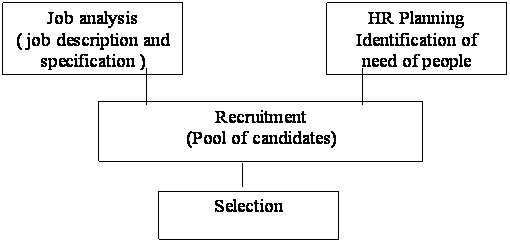
Figure illustrates the relationship among human resource planning, job analysis, recruitment, and the selection process.
clip_image001


RECRUITMENT SOURCES.
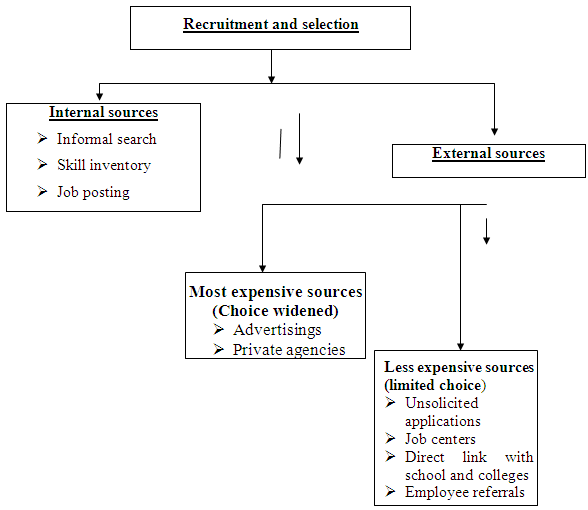
There are mainly two types of recruitment sources are used in the organization.
a) Internal sources
b) External sources
A diagram illustrates these
image